


When you’re weighing dental implants vs bridge options for replacing a missing tooth, the conversation usually starts with two questions: how long will they last, and what do they involve? Both are legitimate tooth replacement solutions, but they work differently, affect your teeth and jawbone differently, and have very different track records when it comes to longevity. Here’s what patients in Miami should know before making a decision.
Implant vs Bridge: Pros, Cons, and Five Things Worth Knowing
- Dental implants are designed to last a lifetime while dental bridges typically need replacement after 10 to 15 years.
- A bridge requires grinding down the two healthy teeth on either side of the gap to support it.
- Implants preserve jawbone density; bridges do not, and bone loss beneath a bridge continues over time.
- Cost matters, but choosing based on price alone is one of the most common reasons implant cases fail.
- The right choice depends on your bone health, gum condition, budget, and long-term goals.
What Is a Dental Bridge?
A dental bridge is a fixed restoration that fills the space left by a missing tooth by anchoring an artificial tooth to the two teeth on either side of the gap. Those neighboring teeth, called abutments, are filed down and fitted with crowns that hold the bridge in place. The result is a seamless-looking row of teeth that is cemented in and not removable by the patient.
Bridges have been used in dentistry for decades and remain a common option for replacing one or more missing teeth. The procedure is generally completed in two to three dental visits and does not require surgery. For patients who are not candidates for implants or who need a faster solution, a bridge can restore function and appearance in a relatively short timeframe.
What Is a Dental Implant?
A dental implant is a titanium post placed directly into the jawbone to serve as an artificial tooth root. Once it integrates with the bone, an abutment and custom crown are attached on top, creating a complete single tooth replacement that looks and functions like a natural tooth.
Dr. Gallardo has a straightforward way of explaining it to patients: “A dental implant is the most natural way to replace a missing tooth. You’re not touching the adjacent teeth. You’re not grinding down adjacent teeth to basically get a three-unit bridge cemented on there where food might get stuck. And over time, the bone starts to shrink and then maybe you’ll need an implant or two anyway.”
That description captures something important. An implant stands on its own. It doesn’t borrow support from neighboring teeth, and it replaces the tooth root itself rather than just the visible crown.
Dental Implants Before & After Photos
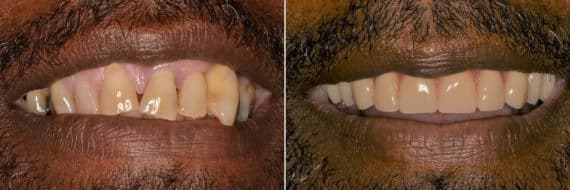
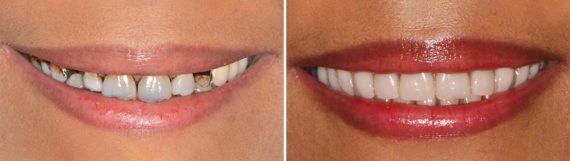
* All patients are unique and individual results may vary.
Key Differences Between Dental Implants and Bridges
Understanding how these two options differ structurally helps clarify why their long-term outcomes are so different.
Structure
A bridge is a three-unit restoration: two crowns on the abutment teeth and a false tooth suspended between them. An implant is a standalone restoration: a titanium post in the jawbone, an abutment, and a crown. Nothing about an implant depends on or connects to adjacent teeth.
Effect on Surrounding Teeth
To place a bridge, healthy neighboring teeth must be permanently altered. Enamel is removed to fit the crowns, and those teeth become structurally dependent on the bridge going forward. With an implant, adjacent teeth are left completely untouched.
Bone Preservation
This is one of the most significant differences. When a natural tooth root is lost, the jawbone beneath it begins to resorb because it no longer receives the stimulation it needs. A bridge replaces the visible tooth but leaves the underlying bone without that stimulation, so bone loss continues beneath the bridge over time. A dental implant acts like a tooth root, transmitting forces into the jawbone and actually encouraging bone density to be maintained, or even increase, around the implant site.
Which Option Lasts Longer?
The answer is clear. Dental implants are designed to last a lifetime. Dental bridges, on average, last 10 to 15 years before they need to be replaced, though some last longer with excellent care.
The difference comes down to what each restoration does — and doesn’t do — for the underlying bone. As bone loss progresses beneath a bridge, the fit changes, the supporting teeth can become compromised, and the bridge eventually fails. An implant that is properly planned, placed, and maintained has no such limitation. Dr. Gallardo puts it plainly: “Implants basically are replacing the missing natural roots, and once an implant is in place in the bone, the bone becomes denser over time.”
What Makes Dental Implants So Durable
Longevity doesn’t happen automatically. According to Dr. Gallardo, three things determine whether an implant lasts 20 years or more.
- Proper diagnosis. Bone quality, gum health, and overall stability have to be evaluated before surgery begins. Skipping this step is often where problems start.
- Surgical precision. Implant position, angulation, and depth matter more than most patients realize. A well-placed implant and a poorly placed implant can look identical on the day of placement and produce very different outcomes years later.
- Long-term tissue stability. Healthy gums and maintained bone are what protect an implant over time. When any of these steps are overlooked, failure becomes a matter of time.
Dr. Gallardo is also direct about one of the most common mistakes he sees: patients choosing a provider based on price rather than expertise. “Implants are not just screws and bone. They require precise diagnosis, surgical training, and a deep understanding of tissue biology,” he says. “When planning is rushed, complications don’t always show up immediately. They show up years later: bone loss, inflammation, implant failure. Doing it right the first time is always the least expensive option.”
A thorough pre-surgical workup at Gallardo Periodontics includes a full intraoral evaluation, assessment of bone volume and gum tissue quality, and a three-dimensional CT scan to identify nerves, sinuses, and bone density before any treatment begins. When bone loss has already occurred, bone grafting may be recommended to rebuild the site before implant placement.

Need a Dental Implant Expert?
ENHANCE YOUR ORAL HEALTH, CONTACT OUR MIAMI OFFICE TODAY!!
When a Bridge May Make Sense for Missing Teeth
A bridge is not the wrong choice for every patient. There are situations where it makes practical sense:
- A patient is not a candidate for implants due to insufficient bone and does not want to pursue grafting.
- Health conditions make surgery inadvisable.
- Time or budget constraints make a faster, less involved solution necessary in the short term.
- The teeth adjacent to the gap already have crowns or significant restorations, making them reasonable abutments.
That said, the limitations are real. A bridge does not address bone loss, it permanently alters healthy neighboring teeth, and it will eventually need to be replaced. For younger patients especially, choosing a bridge today may mean needing implants anyway in 10 to 15 years after additional bone loss has already occurred.
Pros and Cons: How to Make the Right Choice for Your Smile
The right choice depends on several factors, and there is no single answer that fits every patient.
Oral Health and Bone Condition
If active gum disease or significant bone loss is present, those conditions need to be addressed before either option can succeed long-term. An implant placed into an unhealthy site is at risk from the start.
Goals and Timeline
Patients who want a permanent solution that preserves their natural teeth and jawbone are generally better served by an implant. Patients who need a faster resolution or who are not surgical candidates may find a bridge more appropriate for their current situation.
Cost Considerations
Implants cost more upfront than bridges. Over a lifetime, however, the math changes. A bridge that is replaced once or twice, combined with the dental care required to manage bone loss and any complications with the abutment teeth, can approach or exceed the cost of a single implant. The dental bridge cost may appear lower initially, but it is worth considering the full picture.
Professional Evaluation
No comparison of options replaces an actual evaluation. Bone volume, gum tissue quality, bite, and overall dental health all shape what is possible and what will last. A periodontist with specialized training in implant dentistry is the most qualified provider to assess these factors and make a recommendation grounded in long-term outcomes.
Schedule a Consultation Appointment in Miami, FL
If you are weighing dental implants vs. a bridge for a missing tooth, the most important next step is a thorough evaluation by a specialist. At Gallardo Periodontics and Implant Dentistry, Dr. Gallardo works with each patient to understand their goals, assess their oral health, and recommend a treatment plan built for long-term success.
Contact Gallardo Periodontics and Implant Dentistry in Miami to schedule your consultation today.
Frequently Asked Questions: Dental Implants vs. Bridges

About the Author
Dr. John Paul Gallardo is a periodontist and implant surgeon based in Miami, FL, with more than 30 years of experience focused exclusively on periodontal disease and dental implants. He earned his Doctor of Dental Surgery degree from New York University College of Dentistry and completed advanced graduate studies in periodontics and implant dentistry at Boston University. Dr. Gallardo performs over 400 surgical procedures each year and lectures to dental professionals nationally and internationally. At Gallardo Periodontics and Implant Dentistry, every implant case is planned with long-term predictability in mind.